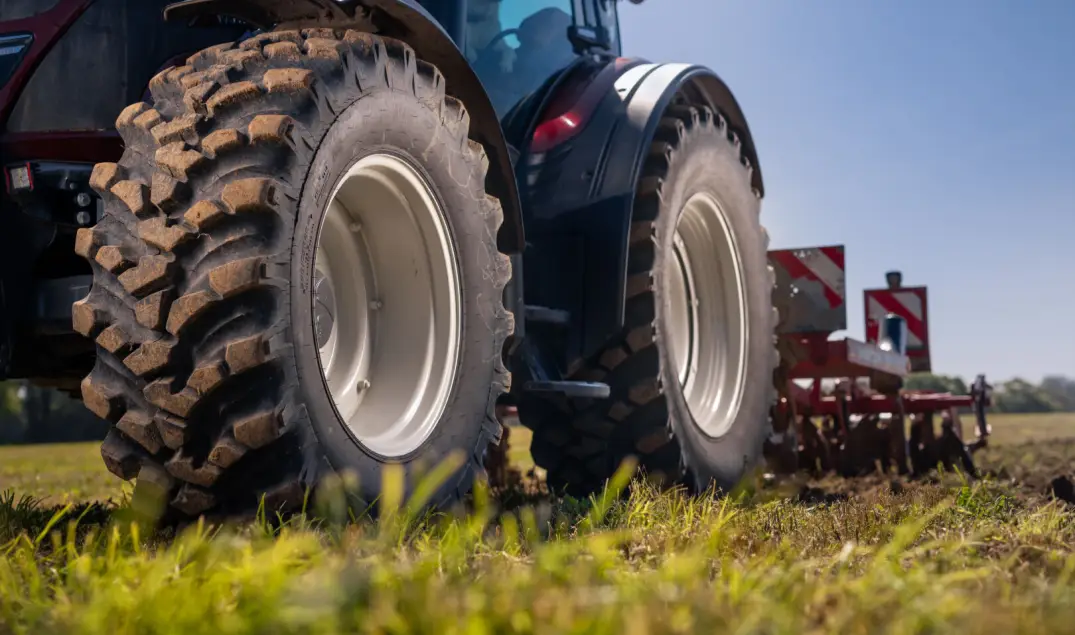
In the world of farming, your tires are the only point of contact between your multi-ton machinery and the delicate soil that grows your profits. Choosing the wrong agricultural tire isn’t just a minor inconvenience; it can lead to soil compaction, increased fuel consumption, and reduced crop yields.
As equipment becomes heavier and more powerful, the “one-size-fits-all” approach to tires is long gone. Here is a practical guide to help you navigate the complexities of modern agricultural tires.
1. Understand the “Compaction” Factor
The biggest enemy of a farmer is soil compaction. When a tire is too hard or too narrow, it compresses the earth, destroying the air pockets and drainage channels that roots need to thrive.
When choosing a tire, your goal is to achieve the largest possible footprint.
Wider Tires (Flotation): These spread the weight of the tractor over a larger surface area.
Low Pressure: The lower the air pressure you can safely run, the less you damage your field.
2. Radial vs. Bias: The Great Debate
In the OTR world, Bias tires still have a place in heavy lifting, but in modern agriculture, Radial is king.
Radial Tires: These are the gold standard for modern farming. Their flexible sidewalls allow for a larger footprint and better traction. Because they run cooler and have less rolling resistance, they can save you up to 10-15% in fuel costs compared to Bias tires.
Bias Tires: These are best suited for older, smaller tractors that don’t do heavy field work, or for utility tasks where sidewall punctures from brush or stumps are a high risk (like forest clearing).
3. The Modern Standards: IF and VF Technology
If you want to offer your customers the best of the best, you need to talk about IF (Increased Flexion) and VF (Very High Flexion) tires.
| Tire Type | Performance Advantage |
| Standard Radial | Base performance, requires frequent pressure adjustments. |
| IF Tires | Can carry 20% more load at the same pressure as a standard tire. |
| VF Tires | Can carry 40% more load at the same pressure, or the same load at 40% less pressure. |
Pro Tip: For high-horsepower tractors and heavy sprayers, VF tires are a game-changer. They allow the machine to “float” over the field while still carrying massive tanks of chemical or seed.
4. Deciphering the R-Series (Tread Patterns)
Not all lugs are created equal. The “R” code tells you exactly what the tire was born to do:
R-1 (Standard Tread): The classic choice for general farming in dry to moist soils.
R-1W (Wet Tread): Features lugs that are about 20% deeper than R-1. This is the “sweet spot” for many modern farmers, providing great performance in a variety of soil conditions.
R-2 (Deep Tread): Designed for extreme mud and “wet” farming (like rice paddies). These have very deep lugs but can be vibrating and uncomfortable on hard roads.
R-3 (Turf Tread): Shallow, diamond-shaped patterns. These are meant for orchards, parks, or golf courses where you want zero soil disturbance.
R-4 (Industrial/Utility): A hybrid between an OTR tire and a farm tire. You’ll find these on backhoes and compact loaders that work on both dirt and pavement.
5. Match the Tire to the Task
Before placing an order, ask these three questions:
What is the Road-to-Field Ratio?
If your tractor spends 40% of its time driving between different farm plots on paved roads, you need a compound designed for wear resistance. If it stays in the field 90% of the time, prioritize traction and flotation.
What is the Maximum Load?
Always calculate the weight of the tractor plus the heaviest implement (like a fully loaded grain cart or a mounted plow). Under-speccing a tire leads to “bead slip” or sidewall failure.
Do I Need “Stubble Resistance”?
With modern GMO crops having stalks as hard as bamboo, “stubble damage” is a real threat. Look for tires with specialized stubble-guard compounds or reinforced tread centers if you are working in corn or soybean fields.
Final Thoughts: The ROI of Quality
As a trading partner, we often see clients tempted by the lowest price point. However, in agriculture, a tire that lasts 20% longer and improves fuel efficiency by 10% pays for itself within the first two seasons.
Choosing the right agricultural tire is an investment in the health of your soil and the efficiency of your harvest.
Ready to upgrade your fleet? Whether you need high-flotation VF tires for a sprayer or durable R-1Ws for a utility tractor, our team is here to help you find the perfect match.